Schedule
HostsWays to Give
HomePlaylistSchedule
HostsEventsOn DemandOur StoryOur TeamWays to Give Become a Sponsor
How to ListenVisit Help CenterContact Us

Find Us on Social Media:

Logo image

Find Us on Social Media:

Download Our Mobile App:

google play icon

About

HomePlaylistSchedule
HostsOn DemandOur StoryOur Team

Community

EventsWays to Give Become a SponsorPressDiversity StatementCareersAnnual EEO ReportDigital Accessibility

Help

Visit Help CenterContact UsHow to Listen

©2025 Classical California

Sweepstakes RulesFCC ComplianceLocal Public FilesCPB ComplianceAnnual EEO ReportPrivacy PolicyCode of Integrity

articles / Chapman Challenge

The Difference Between a Viola and a Viola Da Gamba

Chapman ChallengeViolaPop CultureArts Alive Blog


KUSC’s Alan Chapman has a lot to say about music, but can he say it in 60 seconds? That’s the Chapman Challenge. We ask a question and Alan has a minute to answer it.

Today’s question is from Barbara in Long Beach who wants to know “What is the difference between a viola and a viola da gamba?”

Hit play below to listen to this week’s Chapman Challenge on Arts Alive.


These days the word viola refers to that instrument you find in orchestras and string quartets that looks like a violin, is held under the chin like a violin, but is a bit bigger and lower in pitch than a violin.

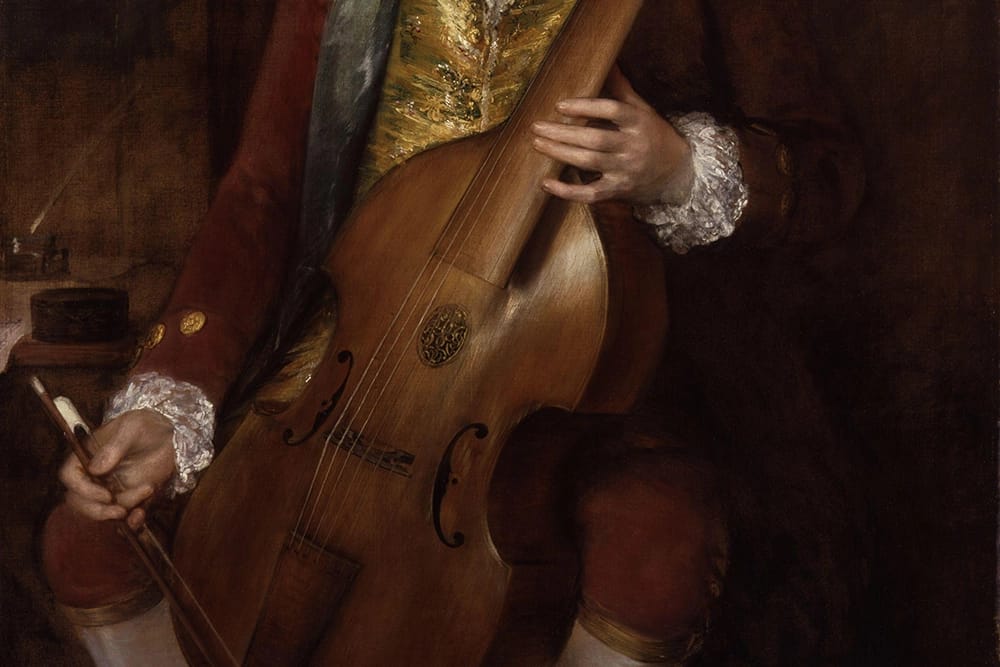
This is a viola da gamba:

Don’t try to hold a viola da gamba under your chin. It’s the predecessor of the cello and it’s of comparable size. The name indicates where you hold it. “Gamba” is the Italian word for leg and it’s held between the legs like a cello.

So let me tell you the difference between a viola da gamba and a cello. The cello has four strings; the gamba has six (or sometimes seven). And unlike a cello, a viola da gamba has frets like a guitar, and that makes it easier to play chords on the gamba.

And, by the way, one of the celebrated gamba virtuosos was Johann Christian Bach’s co-impresario in London, Carl Friedrich Abel.


Karl Friedrich Abel by Thomas Gainsborough

That’s today’s Chapman Challenge. Is there a question you’d like to have answered in 60 seconds? Send it to us at [email protected].

Chapman ChallengeViolaPop CultureArts Alive Blog
Written by:
Alan Chapman
Alan Chapman
Published on 01.24.2020
Loading...

MORE LIKE THIS

How Do You Loan a Stradivarius?

How Do You Loan a Stradivarius?

Explore how rare Stradivarius violins, often owned by foundations or wealthy individuals, are loaned to musicians through intermediaries like the Stradivari Society of Chicago.

03/03/2020
What is the Most Common Key for a Symphony and Why?

What is the Most Common Key for a Symphony and Why?

In this Chapman Challenge, Alan explains why D major is the most common key for a symphony, highlighting its popularity among 18th-century composers like Haydn and Mozart.

03/01/2020
What’s the Relationship Among the Movements in a Symphony?

What’s the Relationship Among the Movements in a Symphony?

In this Chapman Challenge, Alan discusses the harmonic and melodic relationships among the movements of a symphony, using Beethoven's Fifth Symphony as an example.

04/01/2019
Chapman Challenge: What Is a Rondo?

Chapman Challenge: What Is a Rondo?

Explore the rondo, a popular musical form often used in concertos and symphonies, known for its recurring refrain and contrasting sections. Learn how composers play with its structure for listener enjoyment.

04/01/2019
Chapman Challenge: What Is a Chaconne?

Chapman Challenge: What Is a Chaconne?

In this Chapman Challenge, Alan Chapman explains the chaconne, a Baroque musical form built on a repeated series of chords, using Henry Purcell's work as an example.

04/01/2019
Chapman Challenge: What is a Sonata?

Chapman Challenge: What is a Sonata?

In this Chapman Challenge, Alan Chapman explains the origin and evolution of the term 'sonata' in music, from its Italian roots to its use in the Classical and Baroque periods.

04/01/2019